Rebuilding a live commerce platform on Laravel without breaking merchants
What it took to move Shoprocket from CodeIgniter to Laravel while merchants kept selling, the embed kept working, and years of commerce workflows stayed intact.
Based on production work on Shoprocket . This is engineering perspective, not product documentation.
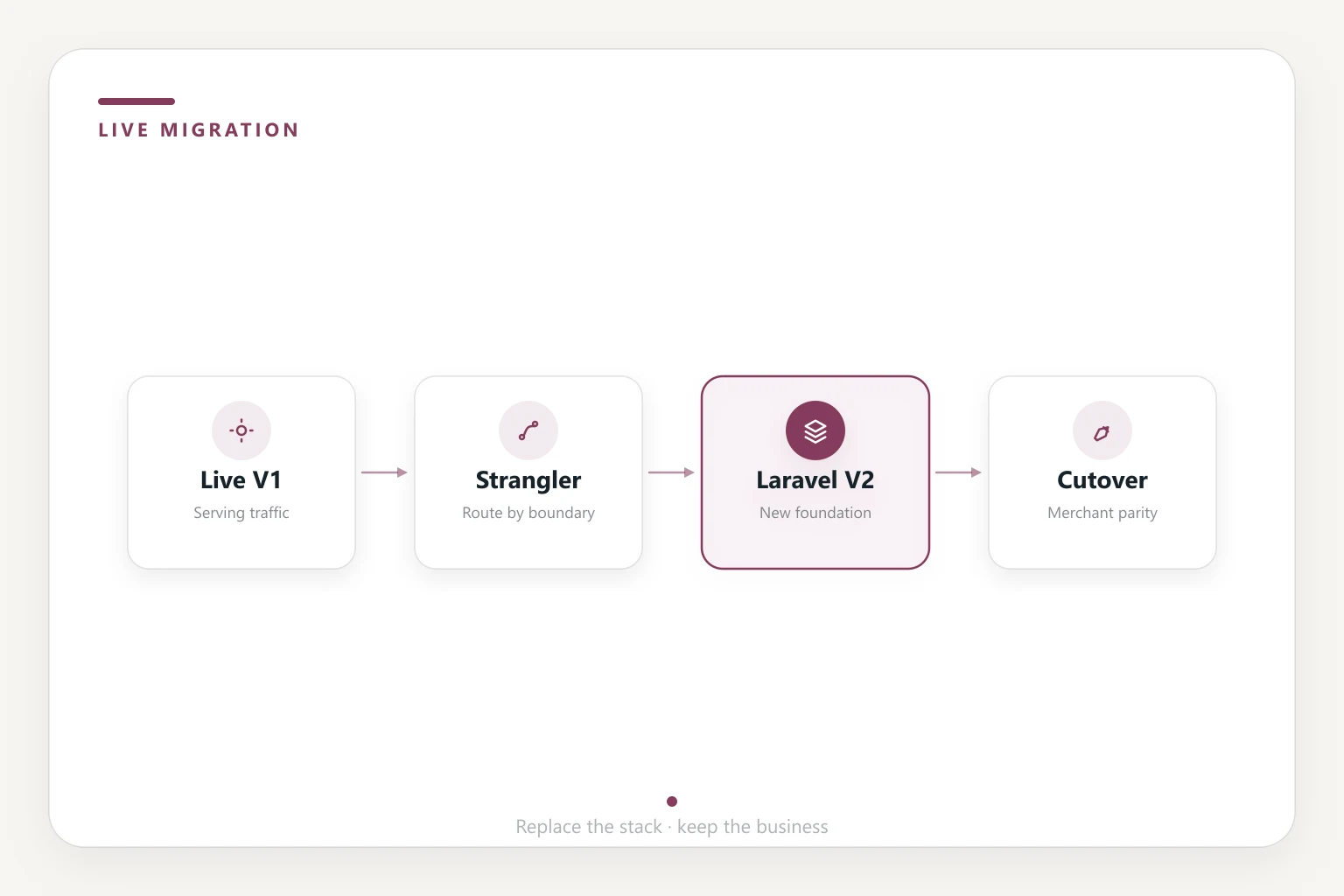
Rewriting a commerce platform sounds clean in a roadmap deck. In practice, merchants were still taking orders on CodeIgniter while we stood up Laravel, Livewire, Alpine.js and Tailwind on Shoprocket. There was no maintenance window long enough to swap everything at once.
I spent years on that transition, mostly on backend, APIs, merchant workflows and the vanilla JavaScript embed that runs on sites we do not control. The hard part was never learning Laravel. It was keeping seven years of workflow history intact while the foundation changed.
Start with behavior merchants rely on
Framework choice does not matter to a store owner waiting on a payout. They care that checkout still loads on their theme, refunds still post, shipping rules still match what they configured, and the embed does not break a product page because we shipped a backend refactor.
Before rewriting a module we wrote down what had to remain true on day one of cutover. That list was usually longer than the wish list for cleaner code.
Replace one boundary at a time
Big-bang rewrites are a luxury live SaaS products rarely have. We routed new work through V2 where boundaries were clear, admin screens, APIs, background jobs, while legacy paths kept serving traffic until we had confidence in parity and rollback.
Rollback plans were not theoretical. We used them when staging parity looked fine and production merchant themes proved otherwise.
The embed migrates separately from the API

Shoprocket's cart runs as vanilla JavaScript on third-party sites. Script order, mobile Safari, conflicting CSS and old jQuery themes do not care that the API is cleaner now. We validated embed changes against real merchant URLs, not only our demo store.
Migrating data is migrating product rules
Catalog rows, tax settings, shipping zones and discount history encode decisions merchants made months ago. Copying tables without checking outputs breaks trust fast. We compared old and new behavior on representative stores and treated mismatches as release blockers.
Keep the scar tissue
Legacy code often looks messy because it remembers production pain: duplicate webhook handling, odd retry paths, shipping edge cases that only appear at volume. Before deleting anything we traced why it existed. Some of that logic moved into explicit services around payment webhooks and order state.
How we knew the rebuild worked
Success was boring operations: merchants kept selling, support volume stayed flat, integrations kept passing webhooks, and the team could ship features again without touching CodeIgniter. Laravel was the right long-term home for Shoprocket. Getting there without breaking live commerce was the actual project.